
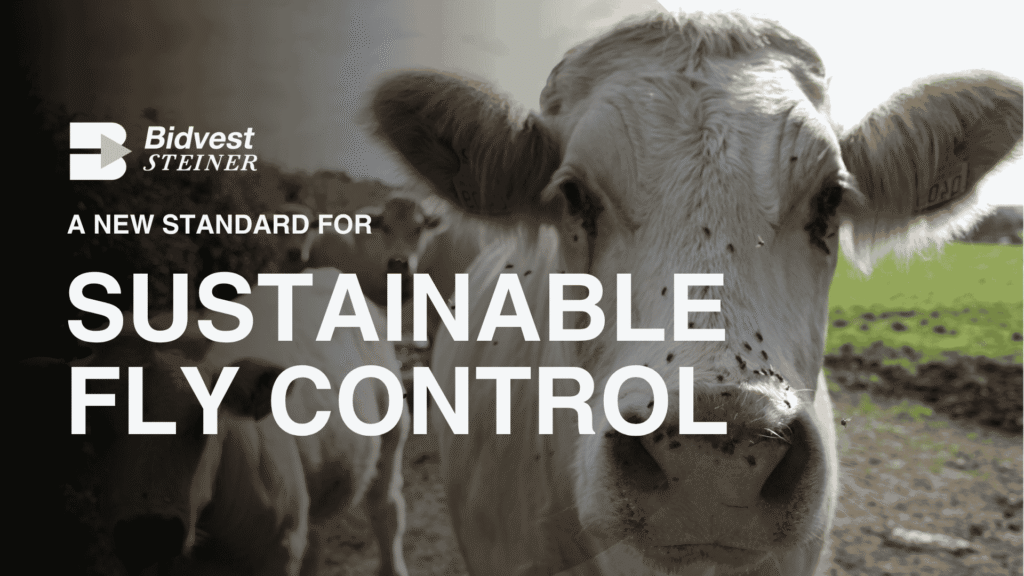

Managing fly pressure in high-organic environments has traditionally relied on reactive chemical treatments aimed at visible infestations. Yet the underlying conditions that allow flies to breed, such as moisture, organic residue, and odour, often remain unchanged.
Through its Blue Planet treatment, Bidvest Steiner has introduced an innovative biological approach to fly management. By targeting the environmental conditions that attract flies and support breeding cycles, the programme enables facilities to reduce fly pressure sustainably while maintaining normal operational activity.
This has resulted in a structured fly control programme built around ACF-32, a biological treatment designed to reduce attractant conditions and disrupt breeding viability over time rather than deliver immediate insecticidal impact.
The operational challenge
This is not a product that “kills flies”. It is a programme that changes the environment in which flies thrive, ultimately making it unattractive for breeding and activity.
Flies are drawn to odours associated with decomposition, fermentation, and organic breakdown. Where organic matter accumulates in drains, fat traps, waste storage zones, livestock bedding, and damp processing floors, fly breeding becomes self-sustaining. Addressing surface-level symptoms does not necessarily reduce underlying pressure.
Bidvest Steiner addresses this cycle through its Blue Planet treatment programme.
How the biological approach works
ACF-32 is a viable bacterial culture suspended in a water-based medium. The bacteria produce enzymes, including proteases, lipases, and amylases, that break down organic matter such as proteins, fats, and carbohydrates.
By accelerating the breakdown of these residues, the treatment reduces the organic substrates that generate odours and attract flies. It can also affect larval habitats, making conditions less conducive to breeding over successive cycles. The aim is not to cause an immediate die-off, but to measurably reduce favourable conditions in potential breeding environments. Bacteria in the solution will produce the exoenzyme chitinase, which interferes with larval development.
A programme, not a spray
One of the strongest features of Bidvest Steiner’s Blue Planet treatment is its structured deployment method.
The process begins with a site assessment. Rather than treating areas where flies are visible, technicians identify source zones with organic buildup. Surface area is measured in square metres to calculate dosage accurately.
The application method is then selected based on the site scale. Smaller environments may use knapsack sprayers, while larger livestock or waste facilities require vehicle-mounted units or boom sprayers.
The first month of treatment typically involves an initial “inoculation” phase, designed to interrupt existing breeding cycles. Thereafter, the programme moves into a maintenance schedule, with frequency adjusted according to environmental conditions and seasonality.
Application follows a documented SOP, including use of unchlorinated water, mixing protocols, even surface coverage and formal treatment documentation. This embeds the programme within an Integrated Pest Management framework rather than positioning it as a standalone intervention.
Where the programme fits
Livestock operations, abattoirs, food processing plants, wastewater treatment works, waste storage facilities, commercial kitchens, equestrian estates and hospitality sites are all suitable environments to adopt this proactive approach.
In these settings, fly pressure is linked to organic loading, drainage systems, waste handling, and moisture management. The ACF-32 treatment is designed for these conditions and performs most effectively within the mesophilic temperature range typical of many operational environments. The biological activity that drives the treatment operates best between 15°C and 45°C, which aligns well with South African climates, and conditions present in many agricultural, food-processing, and waste-handling facilities.
Across multiple high-pressure environments, the Blue Planet programme has demonstrated consistent reductions in fly activity, odour, and breeding viability.
Operational impact in abattoir environments
At a high-throughput South African abattoir processing several thousand cattle daily, treatment focused on blood sumps, open drains, holding pens, and waste areas identified as primary breeding zones. Within two weeks of application, no fly larvae were found during site inspections of treated drains and sumps, and fly activity in these areas was reduced to very low or negligible levels. Odour associated with decomposing organic matter was also eliminated, removing a key attractant driving infestation levels.
Operational impact in poultry operations
Similar results were observed at a large poultry operation in the Free State, where manure accumulation and composting areas created sustained fly pressure. Following initial application, fly visibility reduced by approximately 90% after the first treatment cycle, with no larvae detected after two treatment intervals. Odour across manure pits and composting zones was eliminated, significantly reducing the conditions required for continued breeding.
Operational impact in processing environments
In a current operational deployment at an abattoir in the East Rand in Gauteng, Bidvest Steiner identified key infestation zones, including the condemned area, offal section, and hoof and horn processing areas.
Application in equestrian environments
Equestrian estates present a unique variation of the same challenge. Manure accumulation, bedding material, moisture, and feed residues create ideal conditions for fly breeding in stables, paddocks, and waste areas.
The Blue Planet treatment programme is particularly suited to these environments, as it can be applied directly to manure zones, stable floors, drainage areas, and waste collection points without disrupting animal activity or stable operations. By reducing odour and breaking down organic material, the treatment limits the conditions that attract flies while improving overall hygiene conditions within the estate.
For equestrian facilities, this translates into improved animal comfort, reduced fly-related stress, and better environmental conditions for both horses and staff. By reducing fly activity at the source, the programme also helps limit nuisance levels for nearby residents and supports improved hygiene conditions in surrounding areas, where high fly populations can otherwise become a persistent concern.
These outcomes reinforce a consistent pattern. Where organic load, odour, and breeding conditions are addressed directly, fly pressure declines rapidly and can be sustained through structured maintenance.
Safety and handling
The ACF-32 treatment is not classified as hazardous and presents no known acute exposure risks when handled under normal operational conditions. The biological culture used in the formulation falls within biosafety level 1, indicating microorganisms with minimal risk to people and the environment when handled according to standard procedures.
Pest control reimagined
Bidvest Steiner’s Blue Planet solution does not position ACF-32 as a replacement for all chemical control methods. Instead, it reframes fly management as a structured environmental intervention. By targeting organic build-up and breeding conditions, Bidvest Steiner moves from reactive suppression to sustained pressure management.
For clients operating in regulated or hygiene-sensitive environments, that is an important distinction. The programme introduces measurable routines, documented treatment cycles, and integrated corrective action.
Where traditional pest control focuses on visible symptoms, this approach concentrates on underlying conditions.